
BRCO / Control Rooms / Control Center as a Service
Control center as a service based on an OPEX model
A way to implement the control center as a service—covering infrastructure, technology, support, SLAs, and methodology—without purchasing all the components from day one.
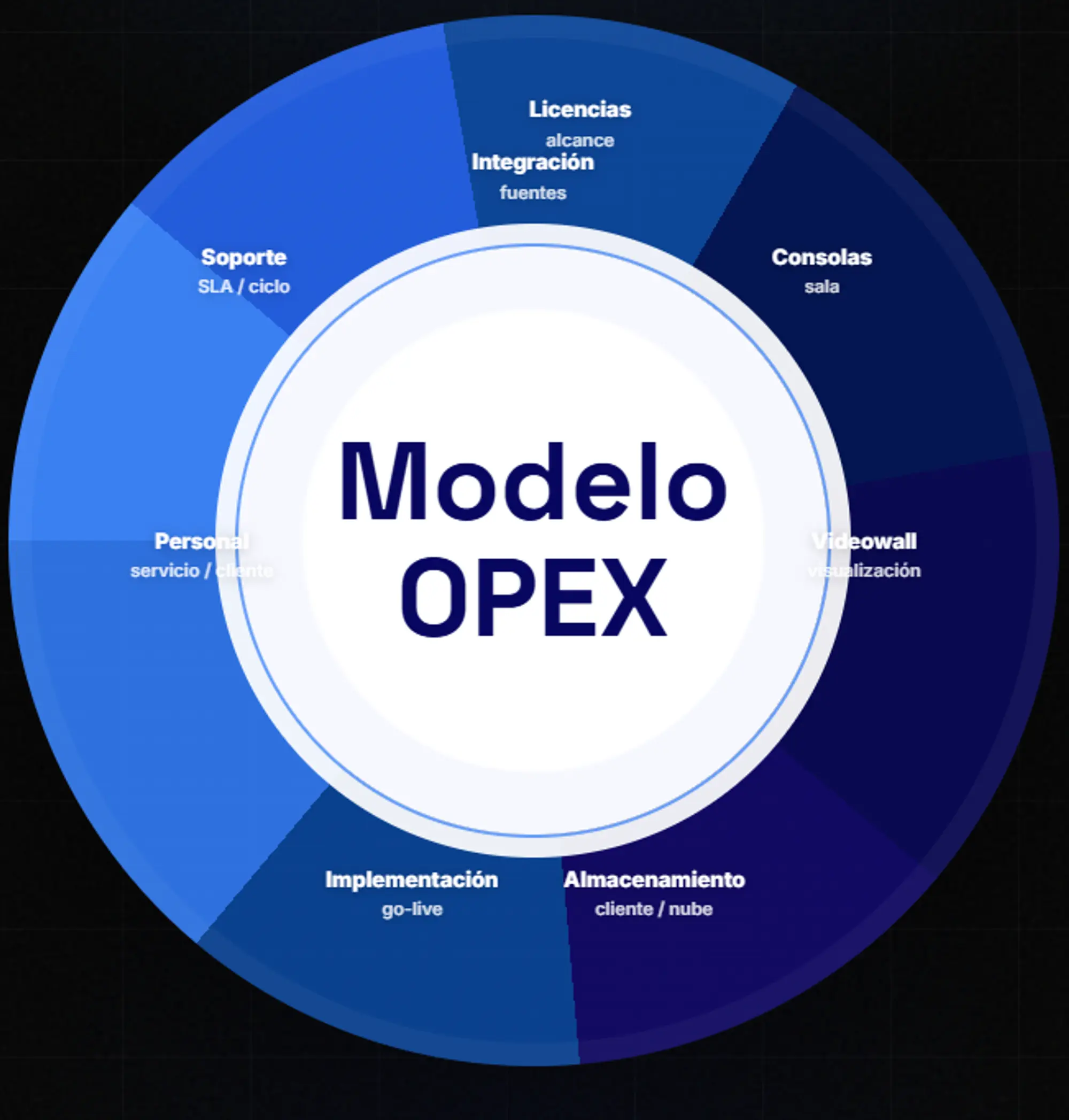
The model may include consoles, video walls, platforms, licenses, storage, personnel, implementation, maintenance, and RemoteCare, depending on the scope.
01 / OPEX Model
The client chooses which components are included in the service fee
CRaaS allows control room capability to be implemented by components. Some can be included in the service fee and others can remain under the client’s responsibility, depending on budget, scope and contract term.
Infrastructure
Consoles, video wall, supports, internal cabling and room equipment.
Technology
Platforms, sources, licenses, storage and integration according to scope.
Operation
Service team, client personnel or a shared model with defined roles.
Lifecycle
Implementation, support, maintenance, SLA, reporting and continuous improvement.
OPEX note: The commercial model is structured as a service. Accounting validation, asset ownership, licenses, storage and internal expense treatment depend on the client’s policies and the contracted scope.
02 / Delivery Models
The service can operate on the client’s premises, off-site or under a hybrid model
Managed operation
The service monitors, verifies, escalates, reports and supports under an SLA and authorized access.
Client-operated model
The client uses its own personnel and keeps daily operation. Implementation, documentation, maintenance and support are covered under the contracted scope.
Hybrid model
The client and the service team share responsibilities: shifts, support, reporting, technical escalation or after-hours coverage.
03 / Methodology and SLA
Clear rules to operate, escalate and report
Each service starts by defining what is monitored, when it is handled, how it is escalated, who receives the alert and how it is reported.
Assess
sources, operation and criticality
Design
scope, roles and responsibilities
Prepare
access, evidence and testing
Define SLA
coverage, priorities and timing
Operate
verify, escalate and record
Improve
reports, reviews and adjustments
| SLA | Defines | Example |
|---|---|---|
| Coverage | Service hours. | Business hours, extended, after-hours or contracted 24/7. |
| Priority | Impact and urgency level. | P1/P2/P3 or criteria agreed with the client. |
| Escalation | Responsible contacts, channels and timing. | Contact matrix and evidence requirements. |
| Reporting | Service traceability. | Logbook, indicators, recurrence patterns and improvement opportunities. |
04 / Responsibilities
What the service covers and what the client retains
| Topic | Criterion |
|---|---|
| Information and storage | It can remain on client infrastructure, in the cloud or under a hybrid scheme. Only authorized personnel access it according to the model. |
| Operational authority | By default, it remains with the client; the service escalates, supports and reports according to contract. |
| Licenses | They can be included in the fee or remain under the client’s responsibility, depending on vendor and scope. |
| Remote control | Only if expressly authorized, tested, documented and contracted. |
Commercial limit: The page does not promise absolute continuity, field intervention, incident resolution or specific accounting treatment unless they are part of the contractual scope.
05 / Outcome
A control room without purchasing everything from day one
Lower entry barrier
The client accesses a control room as a service, with the components it actually needs.
Structured operation
SLA, SOPs, escalation matrix, reports and service reviews organize the operation.
Growth path
It can evolve toward a remote operations center, IROC, RemoteCare or a dedicated control room.
Operational sustainability: when applicable, the model allows existing infrastructure to be reused, oversized purchases to be avoided and lifecycle to be extended through support and continuous improvement.
Define what is included in your service model
We will review components, licenses, storage, staffing, operation, coverage hours, SLA, support and responsibilities to structure a realistic CRaaS proposal.
- Control room design and integration
- KVM and video wall solutions
- Specialized support and maintenance