
BRCO Global EN

AV over IP system for control rooms

BRCO StreamWall IP

Visual distribution over IP for video walls and remote rooms, with modular growth and without concentrating video processing in a single chassis.

Encoders, a managed IP network, decoders, and visual orchestration—integrated through engineering, testing, and documentation. Operator workstations retain a separate KVM architecture for video and USB.

01 / Reference architecture

From source to video wall over the network

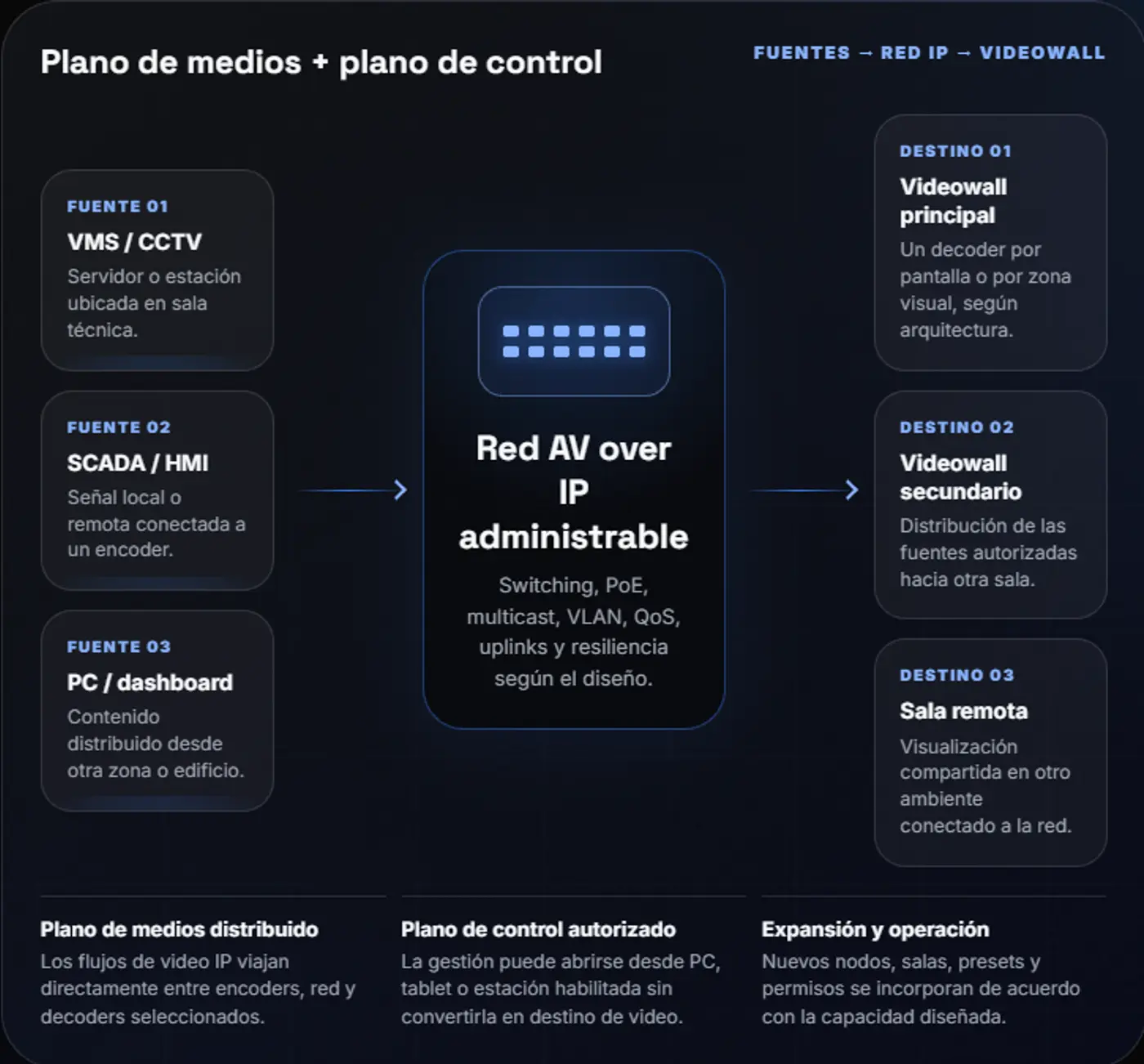
Each signal enters through an encoder, crosses the IP infrastructure, and is reconstructed by the decoder assigned to the visual destination. Management remains separate from the media flow.

01 / Source

Visual sources

PCs, VMS, SCADA, dashboards, cameras, media decoders, and compatible IP streams.

02 / Input

IP encoders

Capture the signal and generate the IP video stream using the profile defined for the project.

03 / Transport

PoE switching / AV network

Distributes streams through managed switching, multicast, segmentation, and properly sized uplinks.

04 / Output

IP decoders

Receive authorized streams and generate the corresponding output or composition.

05 / Visualization

Video walls and remote rooms

LCD, DLP, LED destinations or shared visualization systems.

Control plane

Operations are managed without centralizing the video.

An authorized workstation sends selection, composition, and monitoring commands. Streams continue directly between encoders, the network, and decoders.

Media

Video between nodes and the network.

Control

Commands, permissions, and configuration.

Destinations

Video walls and visualization rooms.

02 / Operations and capabilities

Visual orchestration on a distributed architecture

The platform manages sources, video walls, users, and rooms. The network transports the streams, while compatible nodes perform the defined output or composition.

Operational experience

Visual control and governance

Preview + drag and drop

Preview content and assign it to a display, zone, or video wall from the graphical interface.

Scenes, layouts, and presets

Recall configurations for normal operations, incidents, maintenance, or contingency modes.

Users and multiple rooms

Define permissions by user, source, destination, function, and room, depending on the platform version.

Operations and maintenance

Monitor nodes, links, traffic, alerts, events, and operational logs using the platform tools.

Technology profile

Transport, composition, and deployment

H.264 / H.265 · 4–20 Mbps

Configurable codec and bitrate on compatible nodes.

Up to 16 FHD sources

Multiview available on compatible decoders and configurations.

PoE 802.3at · CAT6 up to 90 m

Power and distance depend on the selected model and certified cabling channel.

Fiber up to 10 km · PoE or local power

Depending on the transceiver, fiber type, topology, and selected model.

Project-specific specification: Resolution, interfaces, synchronization, windows, distances, power, platform, and licenses are confirmed in the datasheet and proposal for the selected configuration.

03 / Use cases

Where a distributed architecture delivers the most value.

StreamWall IP is particularly well suited to projects where point-to-point cabling, physical concentration, or a fixed chassis limits operations and growth.

Extended distances

Video wall remote from the data center

Sources and displays are located in different rooms, floors, or buildings.

Source

Servers and workstations in the technical room.

Destination

Video wall in another operational area.

Distributed sources

Signals across different racks or areas

Source systems should not be relocated or physically centralized.

Capture

Encoder located near each source.

Distribution

Convergence over the engineered network.

Modular growth

Phased deployment

The project starts with controlled capacity and must support future sources, displays, or rooms.

Initial phase

Nodes required for the first stage.

Expansion

Additional nodes within the planned capacity.

Campus and multi-room

Multiple connected visual destinations

A shared infrastructure distributes authorized sources to video walls across different rooms or buildings.

Scope

One or more visualization rooms.

Operations

Local or centralized administration based on permissions.

04 / Engineering, deployment, and support

BRCO's advantage is taking the architecture through to verifiable operations.

We design and integrate from Peru for projects across Latin America. Deployment, on-site services, and support are defined by country, criticality, and contracted scope.

Assessment

Sources, destinations, available network, risks, and operational scenarios.

Design

Topology, models, signal matrix, addressing, and capacity.

Integration

Nodes, switching, displays, platform, permissions, and presets.

Acceptance

Latency, synchronization, switching, recovery, drawings, and backups.

Support

Training, maintenance, and expansion roadmap according to contract.

Network

Multicast, IGMP, VLANs, and QoS

Capacity and segmentation designed to prevent flooding and bottlenecks.

Compatibility

EDID, HDCP, and formats

End-to-end validation from source to visual destination.

Continuity

Power, uplinks, and recovery

Redundancy and procedures aligned with the project's actual criticality.

Governance

Roles, observability, and documentation

Operational control for IT/OT, Operations, and Engineering.

Available to end users, engineering firms, and regional integrators.

The modular architecture supports node-based expansion and reuse of certified infrastructure when engineering conditions allow.

05 / Complementary service

Extend operational continuity with RemoteCare.

The platform provides observability and diagnostics. RemoteCare adds specialist intervention, remote follow-up, and response according to the contracted service level.

Optional · Scope defined by contract
Access

Controlled remote intervention

Authorized sessions for diagnostics and support of equipment included in the service.

Follow-up

Technical review of covered equipment

Analysis of available states, events, and alerts; frequency depends on the contracted plan.

Response

Service-level response

Hours, escalation, reporting, and on-site support are defined in the RemoteCare proposal.

06 / Contact

Define the right configuration.

To size StreamWall IP, we review sources, visual destinations, available network, distances, layouts, permissions, and expected growth.

Useful information

The configuration depends on how signals will be distributed and how the video wall will be operated.

Sources

HDMI/DP, VMS/CCTV, SCADA/HMI, dashboards, and IP video streams.

Visual destinations

Number of displays, geometry, resolution, location, and distances.

Network and operations

Switching, uplinks, layouts, scenes, permissions, and planned growth.

Request a configuration review

The information submitted allows us to prepare an initial technical review of the scope.