
The environment where decisions are made.
Design, modernization, consoles, ergonomics, and workflows for infrastructure built around continuous operations.
Critical industries / Latin America
Specialized infrastructure for end users and integrators across energy and utilities, mining, security, transportation, manufacturing, and healthcare operations.
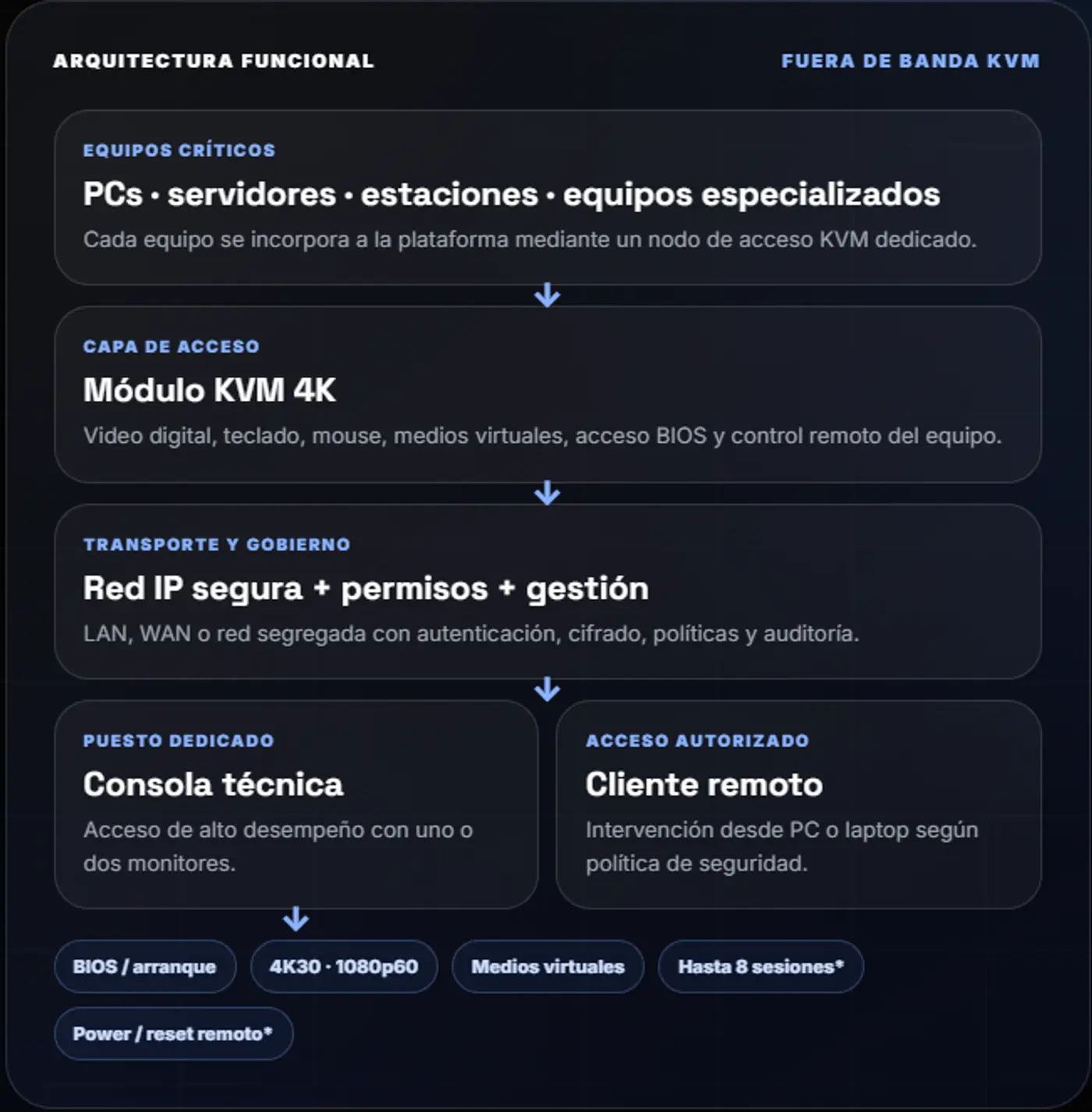
Control rooms, visualization and KVM, plus IoT connectivity, can be integrated within a common architecture. Scope begins with the operation, existing systems, and the project’s actual responsibilities.
We work directly with end users or as a specialist layer within proposals led by integrators, EPCs, contractors, and engineering firms.
We bring technical judgment, coordinated engineering, and clearly defined responsibilities to the project’s critical infrastructure.
We develop control consoles and configurations tailored to the operation, the space, and the approved technical scope.
We coordinate platforms, components, documentation, commissioning, and lifecycle support around the project’s requirements.
Complementary model: specialized capabilities integrate into the partner’s proposal through defined responsibilities, coordinated engineering, and a solution aligned with the end user.
Explore common scenarios, operational priorities, and the most relevant combination of capabilities for each sector. Every project is validated against its technical and operational context.
Substations, generation assets, renewables, distribution networks, meters, and field crews produce signals that must reach operations with visibility, defined access paths, and continuity aligned with criticality.
Structure information, access, and connectivity without turning each site into a technical island.
Sector reference: the final architecture is defined by the operational context, existing infrastructure, coverage, technical compatibility, and contracted scope.
Explore deployments, modernizations, and solutions developed for critical operations.
Control rooms, visualization and KVM, plus IoT connectivity, are evaluated as complementary capabilities within a common architecture. The final combination responds to the process, criticality, and existing infrastructure.
Design, modernization, consoles, ergonomics, and workflows for infrastructure built around continuous operations.
Controllers, AV over IP, and KVM to consolidate sources, distribute them, and access authorized systems with less friction.
SIM/eSIM, shared internet breakout, private networks, controlled human access, and satellite continuity according to the use case.
Before investment: scope, dependencies, failure domains, and priorities.
After deployment: documented coverage, diagnostics, and support for included assets.
Clear responsibilities: SCADA, VMS, OT, corporate, and clinical platforms remain within the responsibilities defined for each project. Our work covers only the contracted operational, access, visualization, and connectivity infrastructure.
Operational sustainability is built through defensible technical decisions: retaining what still adds value, enabling maintenance, and reducing unnecessary intervention.
We assess existing infrastructure to modernize in phases, retain useful components, and avoid replacements that add no operational value.
We prioritize maintenance access, modularity, documentation, and the ability to evolve in order to extend the solution lifecycle.
When architecture and contract allow, remote diagnostics help define the intervention and can reduce travel that adds no value.
Responsible standard: environmental or energy benefits are communicated only when supported by verifiable metrics.
A new control room, a modernization, a connectivity requirement, or a technical partnership each calls for a different starting point.
Assessment of control rooms, visualization, KVM, and M2M/IoT connectivity to identify dependencies, failure domains, and priorities.
Assessment scope index
Evidence-based findings
Prioritized action plan
Direct engagement with the end user or participation as a technical partner within proposals led by integrators, EPCs, and engineering firms.
Engineering and specification
Specialist manufacturing and supply
Integration, documentation, and commissioning
Monitoring, diagnostics, and remote support for controllers, KVM, technical consoles, and expressly covered components.
Documented coverage by asset
Controlled technical access
Essential, Pro, and Full service levels
Defined coverage: RemoteCare is limited to the solution families and compatible assets expressly included in the service; it does not replace a universal third-party monitoring platform.
Share the context, country, your role, and the scope to be structured. We support end users, integrators, EPCs, and engineering firms across Latin America.