
Consistent access
Users connect through a defined access path instead of creating a different method for every device.
Controlled IoT Access
Limited access for technicians, integrators, or manufacturers to defined assets.
The private APN provides the route to the devices. This layer governs human access: identity, destination, service, validity period, and event logging according to the contracted scope.
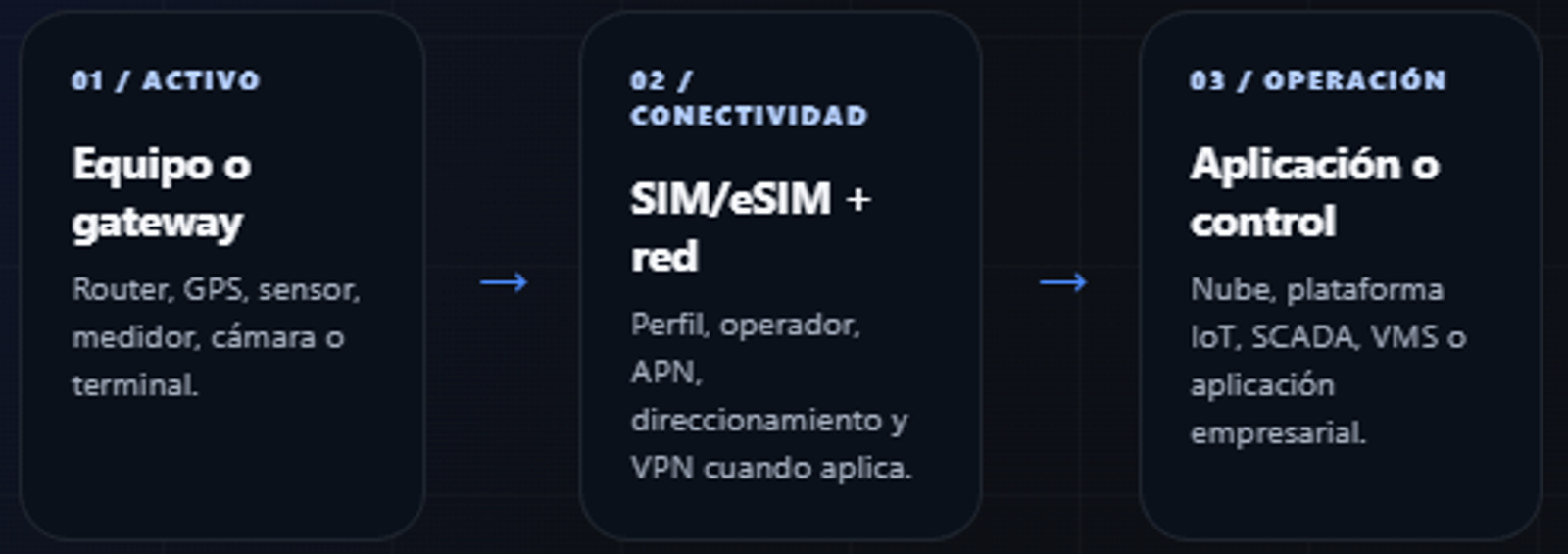
The private route makes the assets reachable. The access-control layer applies a common policy before enabling a human session.
Users connect through a defined access path instead of creating a different method for every device.
Each authorization is limited to the asset, service, and period required for the task.
Integrators and manufacturers can receive separate permissions, managed according to agreed responsibilities.
Session events and status may be retained for support and operational review, according to the contracted scope.
Outcome: a consistent path for internal users and third parties, without turning every asset into a separate entry point.
Private connectivity can remain unchanged. What changes is who operates user access, policies, and logs.
For organizations that need to enable access for technicians or third parties without operating their own remote-access infrastructure.
Best fit: teams without specialized infrastructure or those that prefer to delegate access operations.
User access termination
Policies by user, project, or group
Logging and support according to contracted scope
For organizations that already have a firewall, VPN, or cloud infrastructure and want to retain control of users and policies.
Best fit: IT teams able to operate authentication, permissions, changes, and event review.
Users and authentication operated by the customer
Policies applied on the customer firewall or access platform
Additional component only when required by the design
This decision does not replace the architecture of the Private APN. The private connection between the mobile network and the authorized environment is defined separately.
Access is limited to what the task requires, without granting broad reach across the private network.
Controls that govern user entry to private assets.
Defined point for authenticating and receiving remote sessions.
Separation by user, project, asset, range, or application.
Provisioning, changes, expiration, and revocation according to agreed responsibilities.
Information available for support and operational review, according to the contracted scope.
Additional capabilities included according to criticality, compatibility, and contract.
Monitoring the status and availability of the access component.
Retention or forwarding of events when supported by the platform and scope.
HA or failover design when justified by continuity requirements.
A second endpoint or tunnel, subject to the architecture and environment compatibility.
Responsible scope. The access layer provides authentication, authorization, control, and logging. By itself, it is not a NOC, a device-monitoring service, or comprehensive asset management. Final capabilities depend on the contract and technical environment.
Implementation focuses on users, assets, services, and responsibilities. Private connectivity is treated as a prerequisite and is not redesigned on this page.