
Success story · Citizen security
Private IoT connectivity for a mobile video surveillance operation.
A private architecture to integrate mobile video surveillance with central operations, combining local recording, cellular connectivity, Private APN and IPsec VPN.
01 / Context
A mobile operation needed to integrate with its central monitoring platform.
A municipal entity needed to bring together vehicles, motorcycles and body-worn recording equipment used by security agents within a single video surveillance and evidence management operation.
The need was not simply to have mobile data. The onboard systems had to integrate with the central platform through a private communications environment, while portable evidence required a controlled cycle of capture, download and storage.
The specialty scope was IoT/M2M Connectivity: mobile access, private network and interconnection with central infrastructure.
02 / Architecture
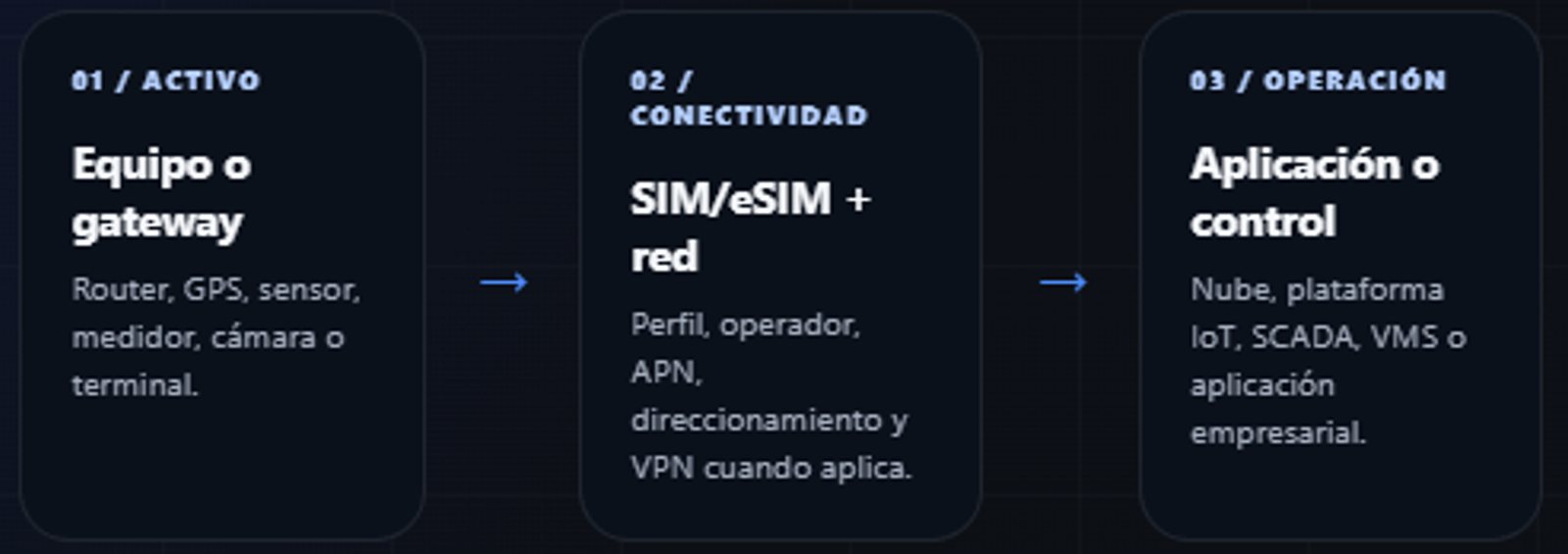
The solution was organized around the asset, the evidence and the operation.
The design considered mobility, video traffic, local storage, network availability and the destination of communications. On vehicles and motorcycles, the cameras work within the unit and an onboard device concentrates the video before sending it to the mobile network.
Local recording and connectivity serve different functions: the edge retains evidence and the network transports to the center what operations need, based on coverage, application and contracted profile.
03 / Field equipment
Three capture fronts, one security operation.
The solution combines onboard video in vehicles, a compact architecture for motorcycles and body-worn cameras as a complementary source of field evidence.
Cameras + mobile recorder + communications
Interior, exterior and driver-monitoring cameras deliver video to an onboard recorder. This concentrates and stores information locally, while the cellular module brings the unit into the project's IoT architecture.
Compact capture and recording kit
The cameras integrate with a main onboard unit that concentrates recording, storage and mobile communication in a package suited to a smaller platform.
Bodycams + docking station
Body-worn cameras complement mobile video surveillance with evidence from the agent's perspective. Information is retained locally during the operation and the docking station centralizes evidence download and device charging upon return to base.
How onboard information travels
The camera does not connect directly to the center: first there is a local capture and storage layer.
Onboard cameras
Generate video within the vehicle or motorcycle.
Recorder or main unit
Concentrates and retains video locally.
Cellular module + M2M SIM
Associates the unit with the contracted IoT profile.
4G/LTE + Private APN
Transports traffic toward the private logical segment.
IPsec VPN + central platform
Delivers communication to the authorized monitoring environment.
The value of being connected.
Evidence does not depend on the link
Local storage allows retaining recordings during temporary coverage interruptions.
Field connected with the center
Operations can access video and events when the application, coverage and contracted profile allow it.
A defined path to operations
Private APN and IPsec VPN integrate mobile assets with the center's authorized infrastructure.
04 / Private network and central operations
The cellular layer transports traffic; the network architecture defines how it reaches operations.
The M2M IoT SIM provides cellular access over 4G/LTE. From there, traffic enters the Private APN, where authorized lines operate within a logical segment with private addressing.
Interconnection to central infrastructure is done via an IPsec Site-to-Site VPN. At the center, the firewall or VPN router receives that communication and the internal network delivers it to the VMS platform, from which authorized workstations manage and view the mobile video surveillance assets.
The architecture also includes a separate route to authorized external destinations when the service requires it. Addressing, routing and destination details remain withheld in the public version.
M2M IoT SIM + 4G/LTE
Brings the onboard equipment onto the mobile service defined for the project.
Private APN
Groups authorized lines within a logical network with private addressing.
IPsec Site-to-Site VPN
Protects communication between the IoT network and the center's authorized environment.
Firewall · VMS · Workstations
Central infrastructure receives, manages and presents information to authorized users.
05 / Result
From mobile asset to central operations with a defined technical path.
The connectivity scope integrated onboard systems with central infrastructure via cellular access, private network and IPsec interconnect. Bodycams complement the operation with portable evidence retained in the field and able to be centralized via their docking station.
Connectivity stopped being treated as isolated cellular lines and became part of the project's operational architecture, combining capture, local storage, transport and central access without making evidence continuity depend exclusively on mobile coverage.
Related solutions
Connectivity was defined as an architecture, not a data plan.
The approach combines mobile access, private network and VPN interconnect according to the asset's needs and can be applied to distributed asset projects in Peru and Latin America, subject to coverage, country and contracted profile.