
Success story · Energy
Remote video verification of electrical substations over a private IoT network.
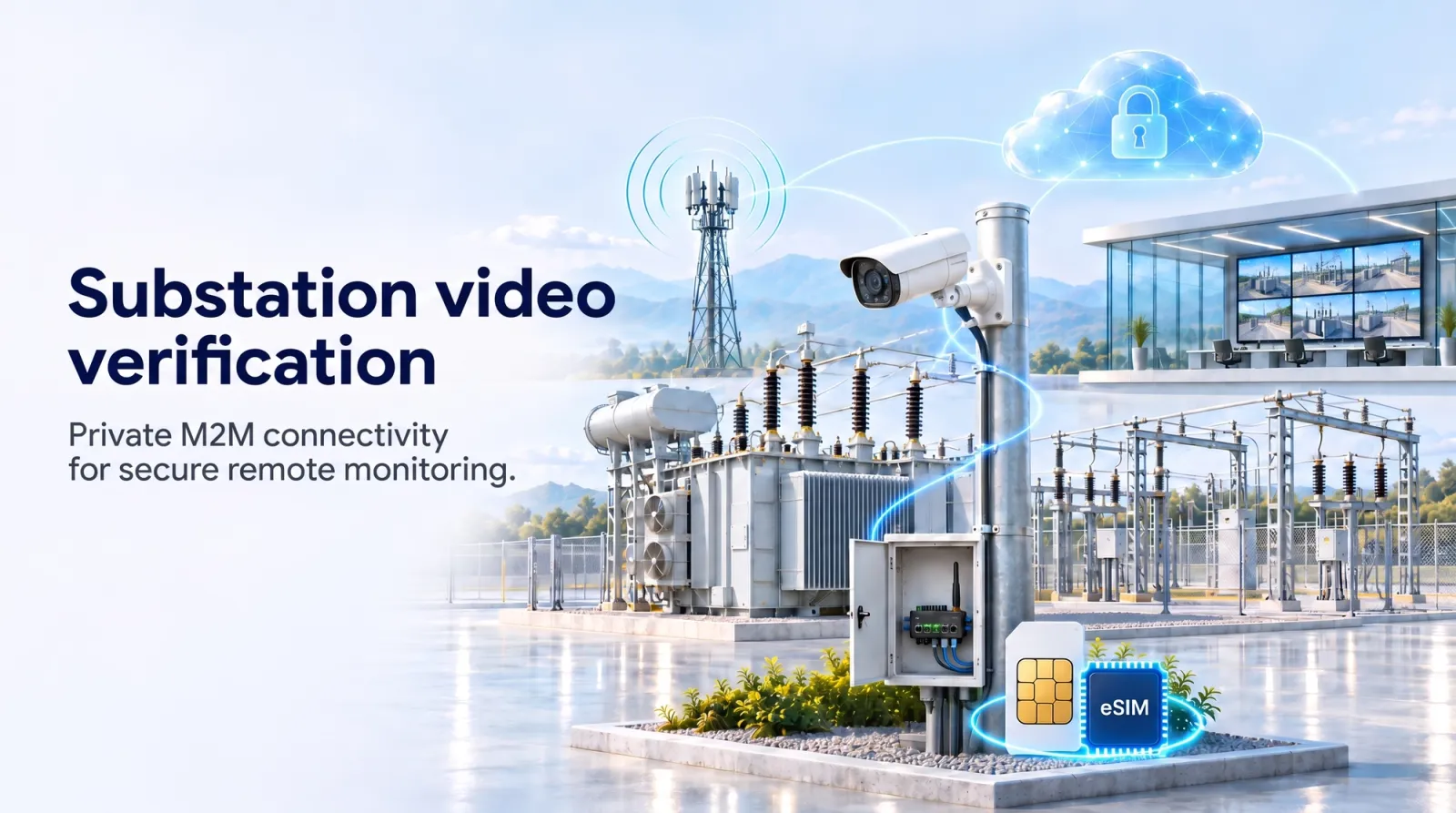
A private architecture to integrate local video surveillance of distributed substations with a monitoring center, without directly exposing field systems to the Internet.
01 / Context
Remote substations without fiber needed video verification from the center.
An electric utility needed to verify alarms, events and movements at distributed substations without depending on on-site visits. At several sites fiber was unavailable, so cellular connectivity was the viable means of integrating the sites with the security control center.
The previous scheme used conventional SIMs with Internet egress. The new architecture had to eliminate that exposure and align with the information security and cybersecurity criteria defined for operations.
The specialized scope focused on IoT/M2M Connectivity and its integration with the existing infrastructure, keeping the video surveillance and connectivity functions clearly separated.
02 / Design criterion
The operation was designed to verify events, not to stream video permanently.
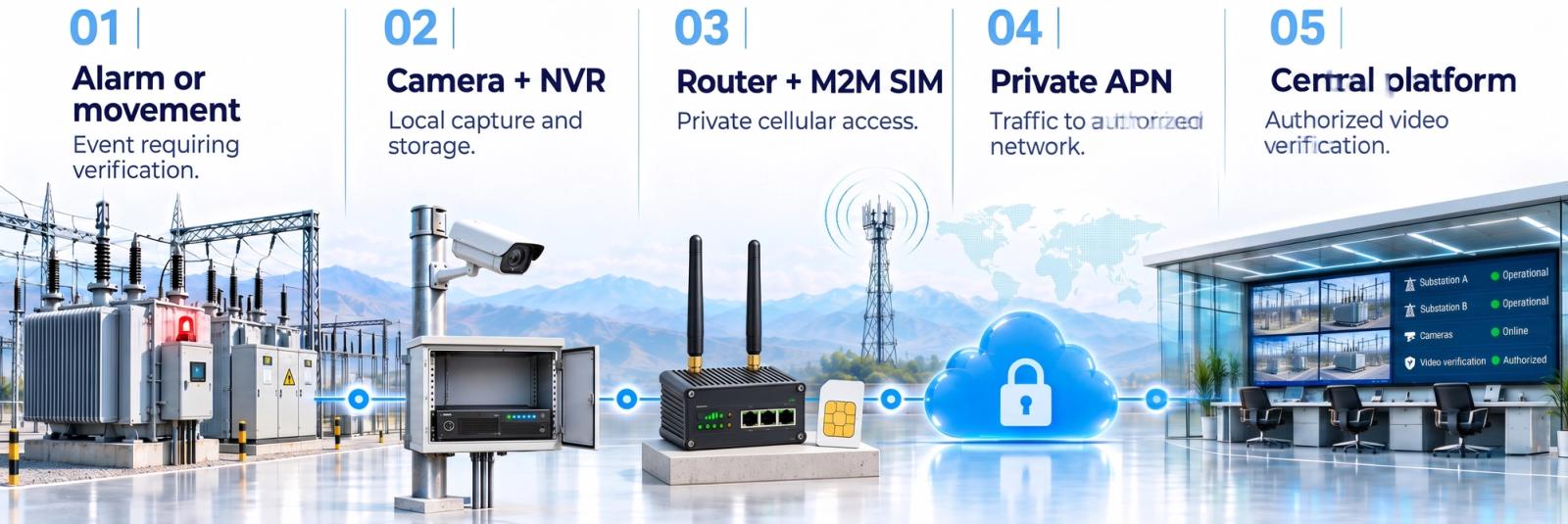
At each substation, the camera delivers video to the NVR or local recorder. The evidence remains on site and recording continues even during a temporary interruption of the mobile link.
On an alarm, event or movement, the operator opens from the VMS the session needed to perform on-demand video verification. The design avoids maintaining a continuous video stream over the cellular link and uses connectivity when operations actually need to check the site.
Each site is integrated via an industrial cellular router recommended for the architecture and an M2M IoT SIM within a private connectivity service, creating a technical pattern that can be repeated at new substations.
03 / Architecture at each substation
Local capture and recording; private connectivity to the center.
The solution clearly separates the video surveillance and connectivity functions. The camera and NVR remain on the local LAN; the industrial router is the entry point to the private mobile network.
Surveillance camera
Records the substation's conditions and events and delivers video to the local recording system.
NVR / local recorder
Stores video locally and maintains recording continuity regardless of the mobile link.
Industrial cellular router + M2M IoT SIM
Connects the video LAN to the private mobile service to integrate the remote site with central operations.
The operational value of the architecture.
Verify remote sites without traveling
Mobile connectivity allows checking substations where fiber does not reach and verifying events from the center without depending on an on-site visit.
No direct Internet egress
The SIMs operate within a private network and traffic is routed only toward the client's authorized infrastructure.
A replicable pattern per site
The same architecture can be extended to new substations while keeping a common model of addressing, access and management.
04 / Private connectivity and corporate integration
The main engineering challenge was integrating mobile connectivity with the client's security criteria.
The M2M IoT SIM uses a Private APN with no direct Internet egress. Traffic is directed via a private interconnect toward authorized infrastructure, without directly exposing field systems over the public Internet.
The integration required aligning connectivity with the network and security policies defined by the client until a scheme compatible with their corporate environment was established.
Topology, addressing, routing and policy details remain withheld in the public version of this case.
Industrial cellular router
Interconnects the video surveillance LAN with the private mobile service.
M2M IoT SIM
Brings each substation onto the managed connectivity service.
Private APN · Private interconnect
Routes traffic only toward the client's authorized infrastructure.
Central platform
Enables video verification from the authorized monitoring environment.
05 / Result
From a connectivity pilot to a replicable model for remote substations.
The pilot validation confirmed the connectivity and integration model, establishing a technical pattern for continuing to bring new sites under the same architecture.
The connectivity scope allows video-verifying events without depending on fiber or exposing equipment to the Internet, while the NVR maintains local recording and the control center accesses the site when operations require it.
M2M/IoT connectivity remains under specialized management, with visibility from the administration platform over the status of the lines and their consumption, providing an additional operational layer for the deployment and growth of the service.
Related solutions
Managed IoT/M2M connectivity
The same pattern can be applied to substations, pumping stations, industrial facilities or other distributed assets that need to integrate video or telemetry with a corporate network via private mobile connectivity, subject to coverage and architecture.